

AI made writing code fast.Now let it ship to production, safely and securely.
Today, every change still waits on a pipeline or a person. With Facets, AI agents ship it themselves. They can only change what you allow, and every change is checked first. Zero pipelines to manage.
A 30-minute call. We show you how it would work with your setup and answer your security questions.
 FacetsThree requests from an AI agent
 production
Run 5 copies of the search service instead of 3
Your rule: scaling from 2 to 10 copies needs no approval
Shipped on its ownOpen port 22 to the whole internet
Your rule: no ports open to the internet
Not allowedDelete the orders database
Your rule: deletes need approval
Waiting for a person
Named in the 2026 Gartner® Market Guide for AI Assistants for Infrastructure as Code



























Every feature needs more than code.
A database, configuration, monitoring, a deployment, a route. Each has its own tool and its own pipeline. Someone has to run them in the right order and approve each step, or hand them to the ops team. So features wait, and AI-written code waits with them.
 Written by AI agents24
- Order trackingCode ready
- Gift cardsCode ready
- Loyalty pointsCode ready
 Suyash KatyayaniCo-Founder and CTO, Purplle
“We had a great development team rolling out features but those features were not seeing the light of day because of DevOps-related problems.”
The fix is to let AI ship too. Today, that's too risky.
Why can't your AI just ship it?
- 01
It would have to run every pipeline.
For that it needs your Terraform, the keys to everything, and the right order in every environment. One wrong step can delete a database.
- 02
Guardrails only block what you thought of.
A guardrail is a list of what AI can't do. Anything that isn't on the list still gets through.
- 03
So a person checks every change.
You're back in the queue, and it gets longer as AI writes more code.
The problem isn't your AI. It's the pipelines.
Not just infrastructure.Ship everything after the code.
Code, configuration, infrastructure, monitoring and alerts go out together in one release, with no pipelines and no hand-offs. New regions and cloud moves work the same way.
Release #418Waiting- Code
- Infrastructure
- Configuration
- Deployment
- Routing
- Monitoring
Build your platform from blocks your team controls.
Here's how one change moves through Facets, from your platform team to your cloud.
A contract says what one piece of your platform needs, what it gives, and the rules it always keeps. AI drafts and tests it, and your team reviews it.
Agents can use the blocks, but they can't change the rules.
What a contract gives youContract · v1.4PostgresGives other services an address and passwordPlain Terraform inside, saved in your Gitpostgres/aws/1.4 · facets.yamlAnyone can changesize: small or medium
Always- encrypted
- backed up daily
- private network
- Compliant by defaultEncrypted and backed up, every time.
- Mistakes caught before they runEvery choice is checked first.
- No driftEvery change goes through Facets.
- No Terraform, no waitingDevelopers pick what they need.
- Connects on its ownAddresses and passwords, wired for you.
- Write once, use everywhereOne contract for every team.
In plain words, or from a menu. Either way, every option they see is one your team allows.
Ask in plain wordsorClaude Code>Add a medium database to checkout
asked by a developer on the checkout teamPick from the menuAdd to checkoutBlockPostgresSizesmallmediumlargenot offered by your teamAddFirst it checks the request against the contract. Then it does each step, in the right order.
Zero pipelines to manage.
The checkAgainst the Postgres contract- Medium is one of your options
- It stays encrypted and backed up
- Nothing gets deleted
- >Turn off encryptionYour contract keeps it encryptedNot allowed
- >Delete the databaseYour rule: deletes need approvalWaits for a person
Every step, doneFacetsRelease #419- Created the database
- Stored its password in your vault
- Connected checkout to it
- Released it to staging, then production
- Added alerts and a dashboard
0 pipelines0 hand-offsplain Terraform, in your own cloud accountNiyo's security team checked every change by hand for months. They never found a problem Facets had missed.
Work that took a quarter now takes days or weeks.
Because every piece is a contract, a big job splits into small changes. Many AI agents can work on them at once, and Facets keeps them in order.
- One big job
- Many small changes
- Many AI agents at once
- Facets keeps the order
- Cloud migrationAWS to Google Cloud.Done inUnder 4 weeksPlanned 3.5 monthsHow we run cloud migrations
- New region1,000+ resources, mostly hand-built, brought in as is, then copied to the EU.EU region set up in3 weeksUsually takes monthsAdopting existing infrastructure
- Release frequencyReleases for 100+ engineers, including air-gapped ones for a partner bank.Releases a month~2,000Read case study80% of them fully self-serveDeployment options
- Multi-cloudTheir Azure event processing, moved to Google Cloud with zero customer downtime.Done in2 weeksRead case studyEvent processing costs down 60%Multi-cloud and migration
- New environmentEach new production environment, as they grew into new regions.Person-weeks, before → after64 → 8Read case studyEnvironment management
- New tenantsEach new customer of their hotel software gets its own setup, from one template.Each new customer set up inMinutesRead case studyBefore DaysCustomer environments for SaaS
Bring anything to Facets.
Your clouds, your tools and the setup you already run. Each one joins Facets, so AI can read it and act on it, and it stays the way your team set it up.
 Vault · Security and secrets
 Terraform · Infrastructure code
- AWS · Clouds
 OpenTofu · Infrastructure code
 OPA · Security and secrets
 Argo CD · Kubernetes and deploys
- Claude Code · AI agents
 Cursor · AI agents
 GitHub Actions · CI
 Grafana · Monitoring
 Google Cloud · Clouds
- Facets
 Azure · Clouds
 Datadog · Monitoring
 Jenkins · CI
 Praxis · AI agents
- Your own agents · AI agents
 Prometheus · Monitoring
 Falco · Security and secrets
 Kubernetes · Kubernetes and deploys
- Private cloud · Clouds
 Helm · Kubernetes and deploys
Anything with a Terraform provider can join. What you run today comes in as it is. Nothing is deleted or rebuilt.
- Clouds
- AWS
- Google Cloud
- Azure
- Private cloud
- Infrastructure code
- Terraform
- OpenTofu
- Kubernetes and deploys
- Kubernetes
- Helm
- Argo CD
- CI
- GitHub Actions
- Jenkins
- Monitoring
- Prometheus
- Grafana
- Datadog
- Security and secrets
- Vault
- OPA
- Falco
- AI agents
- Claude Code
- Cursor
- Praxis
- Your own agents
- And the restAnything with a Terraform provider can join.What you run today comes in as it is. Nothing is deleted or rebuilt.
Or try Praxis, our AI agent, from your terminal:
$ brew install --cask Facets-cloud/tap/praxis
Run Facets hosted by us or in your own account. Either way, your apps and data stay in your cloud.
Hosted by us
Your company gets its own copy of Facets, isolated from other customers. There's nothing to install, and you connect your cloud with a script you run yourself.
In your own cloud account
Facets runs inside your AWS, Azure or Google Cloud account, and all its data stays there. Once it's set up, you control our access: grant it for upgrades and support, remove it any time.
In production in BFSI, healthcare, SaaS and D2C.
- BFSI
- Healthcare

- SaaS
- D2C
Only your copy of Facets holds the cloud keys. AI agents never see them.
Every change is logged: who asked for it, a person or an agent, and who approved it.
Everything is standard Terraform, saved in your Git repository.
Single sign-on
OktaGoogleMicrosoftand others


Teams already shipping with Facets
Read the customer stories
“We onboarded on Facets for more of a promise, but very happy to see the platform has delivered on that promise.”


For the community
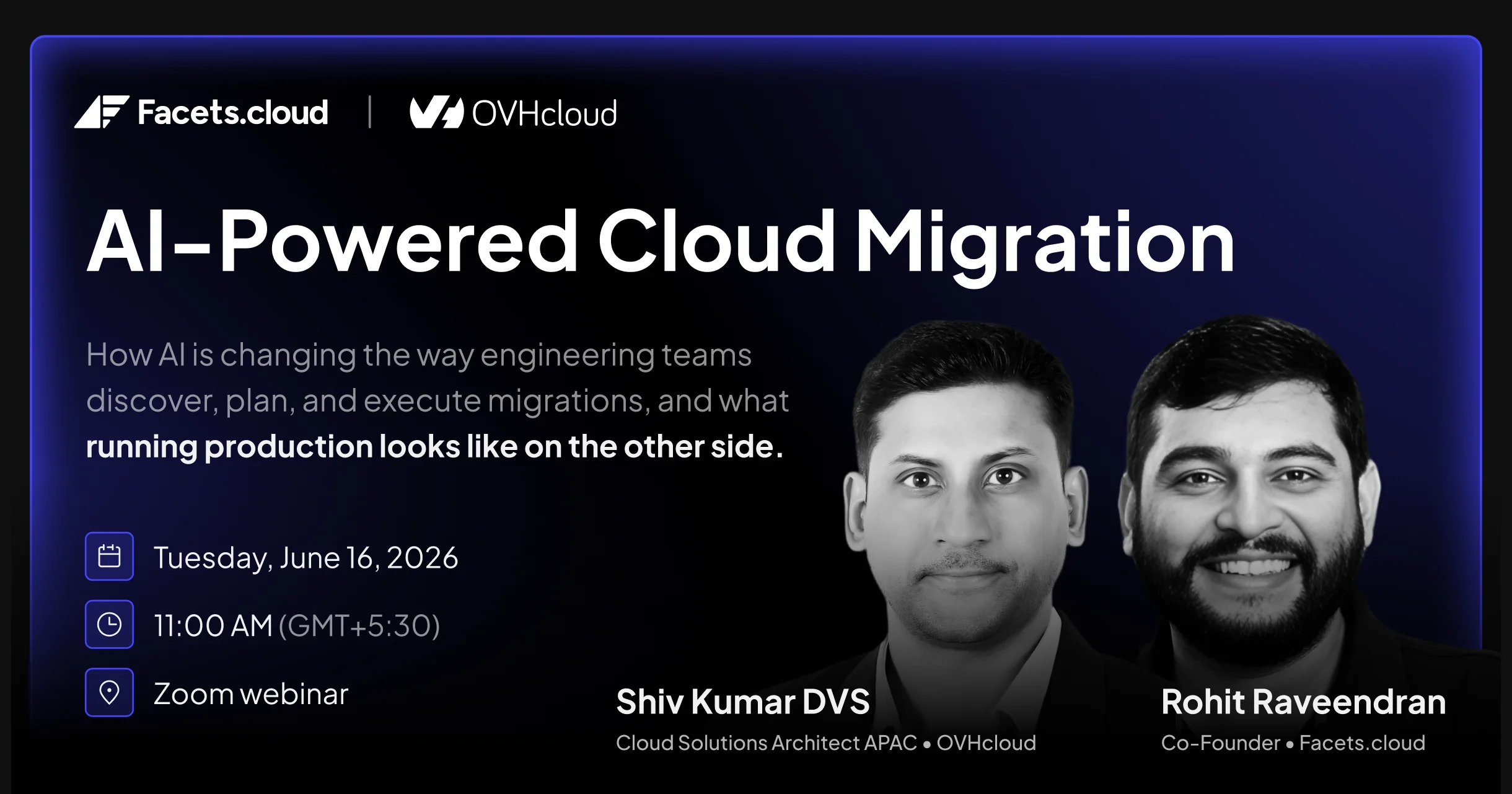 Webinar
AI Cloud Migration: Facets.cloud × OVHcloud
Watch webinar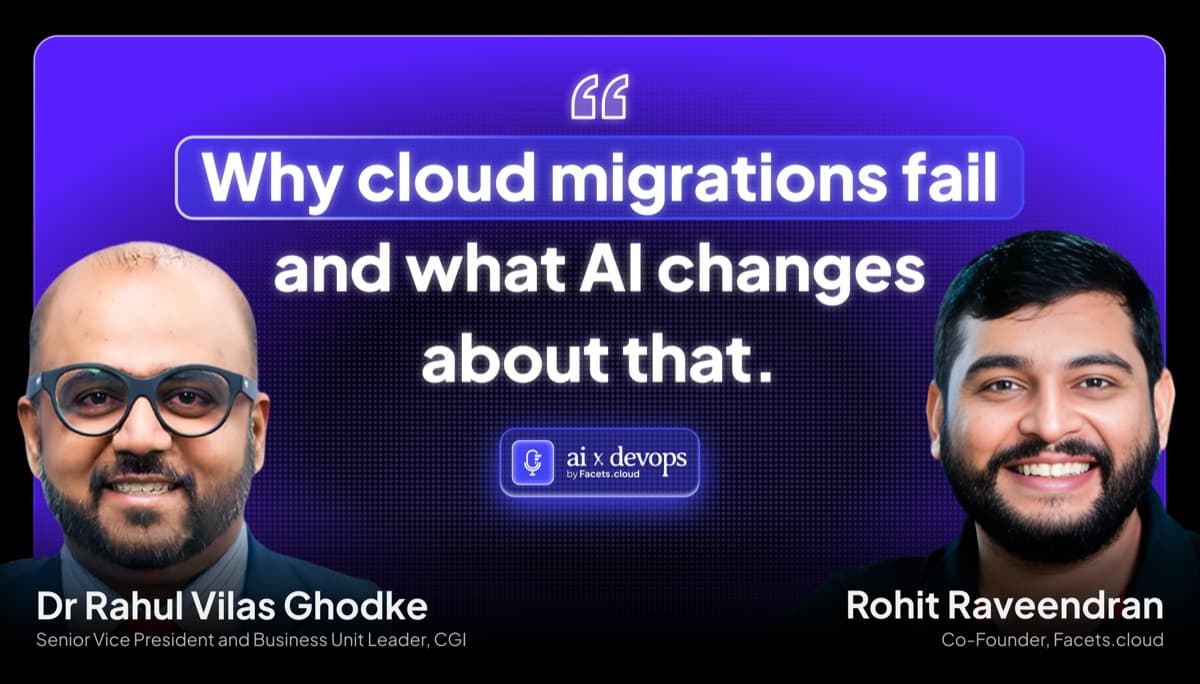 Podcast
Why cloud migrations fail and what AI changes about that
Listen now Case study
How Niyo Achieved 2,000 Releases a Month, While Strengthening Compliance
Niyo, a fintech with 160+ engineers, achieved 2,000 releases a month, 80% fully self-serve deployments, policy-as-code InfoSec governance, and the ability to deploy air-gapped infrastructure for partner banks, all under 6 months.
Read case study- Blog
Facets Cloud's AI Assistants for Infrastructure as Code Recognition Now Spans a Market Guide and 5 Gartner Hype Cycles
Facets Cloud, and its Facets Intelligence (Praxis) product, is now cited across Gartner's inaugural Market Guide for AI Assistants for Infrastructure as Code and 5 different 2026 Hype Cycles. What changed, why it matters, and how Facets Intelligence delivers on what this market demands.
Read article - Blog
Facets Named Representative Vendor in Gartner's Market Guide for Infrastructure Automation & Orchestration Tools
Facets has been recognized as a Representative Vendor in Gartner's Market Guide for Infrastructure Automation & Orchestration Tools, in both the 2025 and 2026 editions. As DevOps shifts toward platform engineering, this recognition validates our belief that infrastructure should be defined once and delivered everywhere.
Read article - Case study
Spectrum Migrates Their Multi-Cloud Azure + AWS Setup to GCP with Facets
How Spectrum worked with Facets to bring its production workloads from AWS and Azure onto a single platform on Google Cloud, eliminating cross-cloud overhead, cutting event processing costs by 60%, and unlocking the headroom to grow customers without growing operations.
Read case study
Questions
Book a walkthroughTell us what you're working on.
- 1You tell us what you're working on.
- 2We show you how Facets would work with your setup.
- 3We answer your security questions.
Not ready to talk? Try it free for 14 days or read the docs.
